Solutions
Chapter 1
The sequence of 17 numbers and letters gives a a cardinal direction (North, South, East, West) or ordinal direction (North West, North East, South West, South East) and number of steps to take. This describes a sequence of steps on the 6x6 grid above, using the conventional upward-pointing north. There is only one way in which the sequence of steps can fit into the 6x6 grid, leading to the message
WHAT IS 3 TO THE POWER 4
The answer is therefore 3x3x3x3=81.
Chapter 2
The plaintext is made of the first two letters from each word.
What is the first prime number that is greater than one hundred.
The first candidate number, 101, is indeed prime because it has no divisors other then 1 and itself. There answer is therefore
101.
Chapter 3
The first step is to identify the flags, the English names of which are:
| Yemen |
Oman |
Uganda |
Romania |
Tuvalu |
Albania |
| South Korea |
Ireland |
Seychelles |
Tanzania |
Oman |
Sierra Leone |
| Trinidad And Tobago |
Ecuador |
Turkey |
Honduras |
Egypt |
Norway |
| Uruguay |
Mali |
Bhutan |
Estonia |
Russia |
Oman |
| Finland |
Solomon Islands |
Denmark |
El Salvador |
Oman |
Netherlands |
| Australia |
Namibia |
Italy |
Canada |
Oman |
Saudi Arabia |
| Hungray |
Ethiopia |
Djibouti |
Rwanda |
Oman |
Niger |
Putting together the first letter(s) of each country we get
Your task is to state the number of sides on an icosahedron
The icosahedron has 20 triangular faces. Each face has three edges but each edge is shared by two faces, so the answer is 20x3/2 =
30.
Chapter 4
This is a knitting pattern, with instructions for the number of Knit and Purl stitches in each row. Alternate rows of stiches are knitted first left-to-right, then right-to-left, so the pattern is specified in this way (it is
boustrophedonic). The 'background' of the knitting pattern is made up of stockinette stitch, which consists of alternating rows of Knit and Purl stitches. Drawing out the pattern of stitches gives the following:
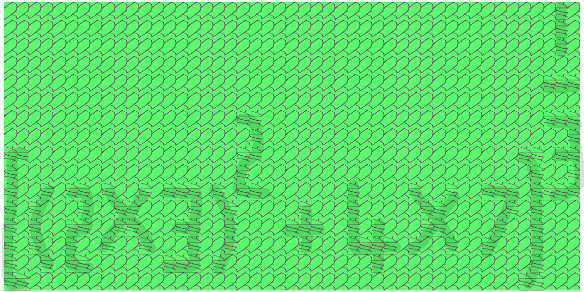
which we read as [(2×3)² + 4×7]^(1/3) =
4.
Chapter 5
The plaintext, including spaces and punctuation, was first enciphered in hexidecimal using ASCII. ASCII is a standard way of encoding letters and symbols using numbers from 0 to 255; in base 16 (hexadecimal) this is 00 to FF. See https://en.wikipedia.org/wiki/ASCII. For example, the letter A is symbol number 65 (in base 10) in ASCII, which is 41 in base 16 (4 times 16 plus 6 is 65). B is 42 is base 16. J is 74 is base 16, which is represented as 4A (4 times 16 plus 10) in base 16. A space is 32 (in base 10) which is 20 in base 16. You can see a list of all ASCII symbols and their base 10 and base 16 representations at the Wikipedia page above.
The coded message them scrambles up the digits for each symbol at random. The larger and bolder of the two digits is the left-most digit, and the smaller of the two digits is the right-most digit. So, for example A could be 65 or 56, a space could be 20 or 02.
The plaintext is
I WISH MY PARENTS WOULDN'T WASH MY PILLOW CASE. EVERY TIME THEY DO, IT SHRINKS: THE LENGTH BY A FACTOR OF TWO AND THE WIDTH BY A FACTOR OF 3. AFTER FOUR WASHES THE SURFACE AREA IS ONLY 6 CM^2. THE LENGTH WAS ORIGINALLY 96 CM. WHAT WAS THE ORIGINAL WIDTH?
Suppose the original length is
l and the original width is
w. After four washes, the new length and width are
l/2
4 and
w/3
4. Hence
l/2
4 x
w/3
4 = 6. The original length is
96cm. Solving this for
w gives that
w =
81cm.
Chapter 6
The cyphertext consists of a list of symbols which are either
- A polygon followed by a letter
- A letter followed by a polygon
- A letter within a polygon
If a polygon is followed by a letter, that letter is shifted earlier in the alphabet by the number of sides on the polygon. If a letter is followed by a polygon, that letter is shifted later in the alphabet by the number of sides on the polygon. If the letter is within the polygon, the letter is not shifted and the number of sides on the polygon does not matter. Decoding in this way, the plaintext is:
Ten numbered balls are in a bag, each with a different number. One ball is taken out of the bag and put on a table. Another ball is then taken out of the bag. What is the probability that the number on the second ball is of greater value than that on the first?
The answer to this is a half, or
0.5.