Solutions
Chapter 1
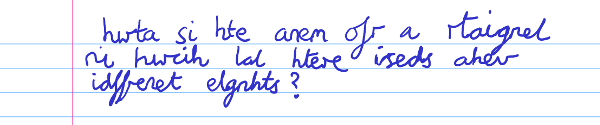
This is an example of a so-called transposition cipher, where the letters in the cipher are the same as those in the plaintext, but in a different order. Here, each adjacent pair of letters in each word of the cipher are transposed, to give the plaintext
Chapter 2
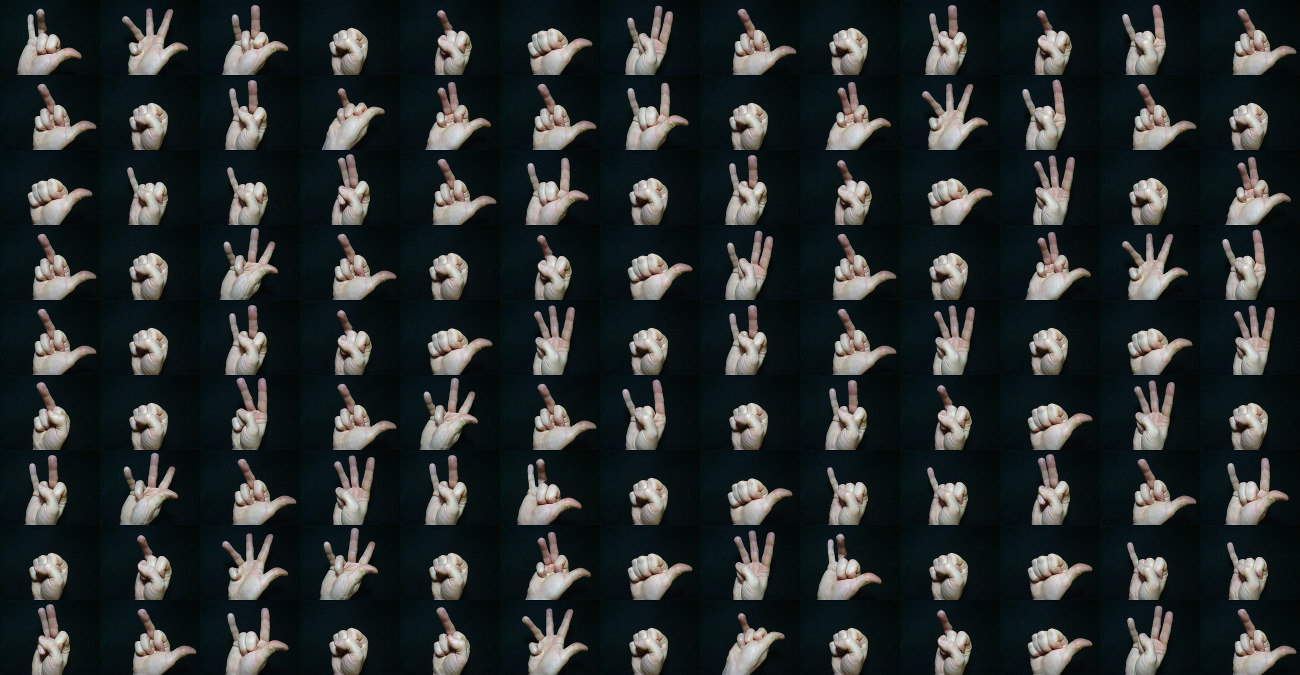
In each picture, each finger and the thumb is either extended or closed. This forms a binary number code, in which an extended finger means "1" and a closed finger means "0".
The binary number is formed by adding 1 if the thumb is extended, 2 if the first finger is extended, 4 if the middle finger is extended, 8 if the middle finger is extended, and 16 if the little finger is extended. For example, in the top left image, the thumb, fourth and little finger are extended, giving a sum 1+8+16 = 25. This corresponds to the 25th letter of the alphabet, "Y". Continuing this, reading from left to right, and top to bottom, gives the plaintext
For each apple I have, you have three, so the total number of apples is a multiple of 4. The multiples of 4 that are more than ten and less than twenty are 12 (in which case I have 3 apples and you have 9), and 16 (in which case I have 4 apples and you have 12).
The hint to work out which of these is the answer is in the question: the answer is a little odd. This means that the answer is three.
Chapter 3
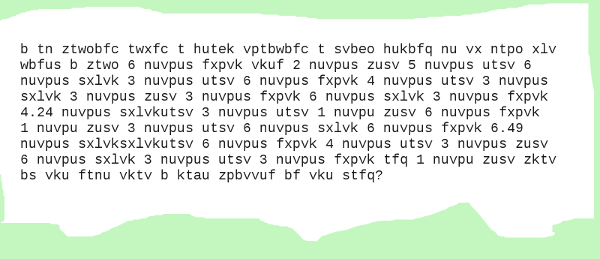
This is a classic substitution cipher: each letter in the cipher represents another in the plaintext. A good place to start decoding is the single letter words "b" and "t", which must correspond to the single letter words "a" and "I" in English, though we don't immediately know which way round. Examination of two and three letter words suggests that "vku" likely represents "the", and so on. With a bit of experimentation, we find the plaintext
Following the instructions, we trace out the letters:
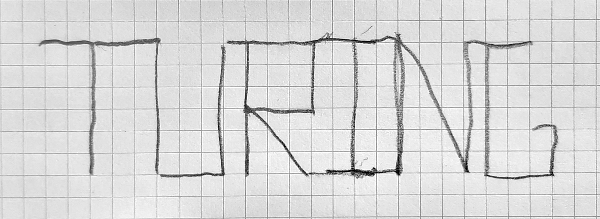
The solution is therefore Turing.
Chapter 4
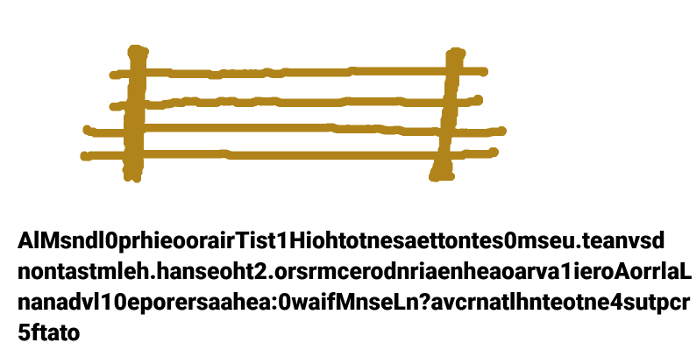
As the message and picture hint, this is a Rail fence cipher with four rails. The ciphertext is written in a zig-zag pattern on four lines ('rails'), revealing the plaintext:
| A | l | M | s | ... | |||||||||||||||||
| t | n | e | s | a | e | t | ... | ||||||||||||||
| r | i | a | e | n | h | e | ... | ||||||||||||||
| a | v | c | ... |
Chapter 5
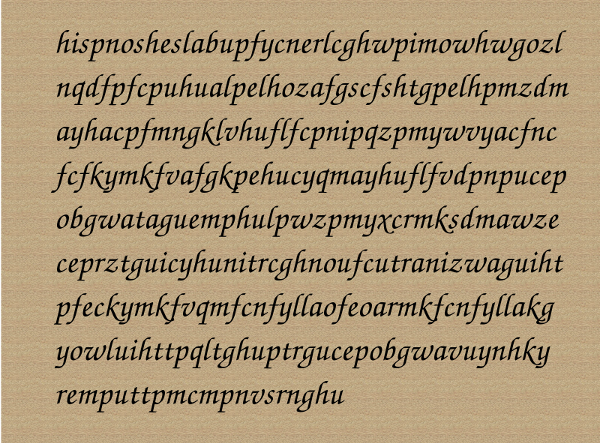
With the text playing fair, the question hints that this is a Playfair cipher. Such a cipher requires a secret key, in this case the letters HAVEFUN. The plaintext, with punctuation added, is
Let $ M$, $ E$, $ B $, $ H $, $ D $ represent the ages of Mike, Ellie, Barquith, Hope and Darcie, respectively. Hope's statement tells us that $$ B = H+50 $$ and Barquith's statement about the mean tells us that $$ \frac{1}{5} ( M + E + B + H + D) = 36.$$ Combining these and rearranging to find $ B $, we find $$ B = \frac{230 - (M + E + D)}{2}. $$ Now, we are told that the mode of the ages (the most common age) is fifteen. This means that the at least two people must be fifteen. The median (age of the middle person when ranked in age order) is sixteen, which tells us that one is sixteen, although we don't know which of Mike, Ellie and Darcie this is. Either way, we have $$ M + E + D = 15 + 15 + 16 = 46, $$ giving $$ B = \frac{230 - 46}{2} = 92. $$
Chapter 6
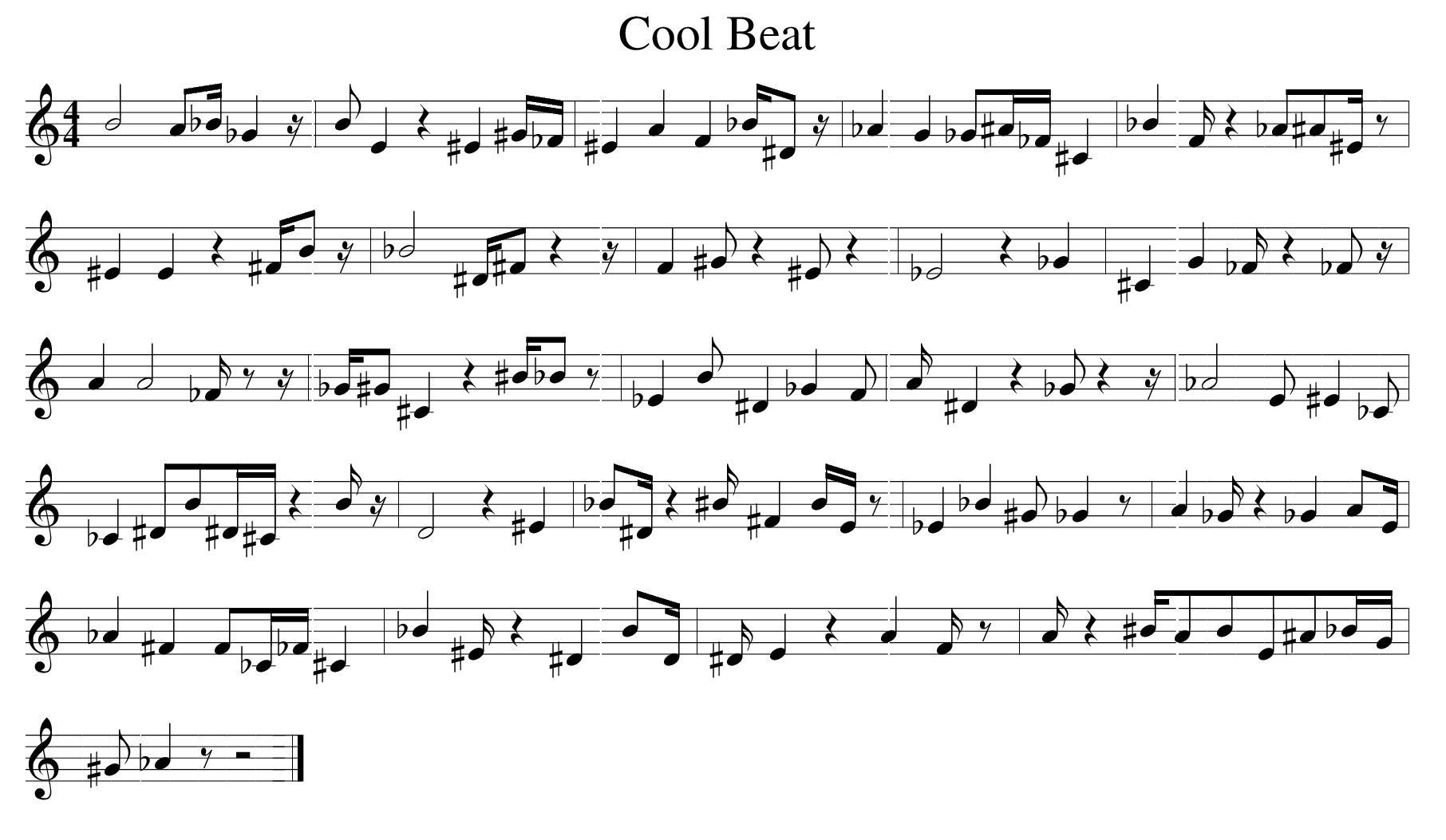
In this code, each note corresponds to a letter. Each letter can be represented by more than one symbol, however, making the code polyalphabetic. The musical letters A, B, C, D, E, F, G correspond to the shortest duration notes in the music (semi-quavers). The accidentals (sharp and flat symbols) are used to change the letter up or down by one. All symbols used are shown in the image below.
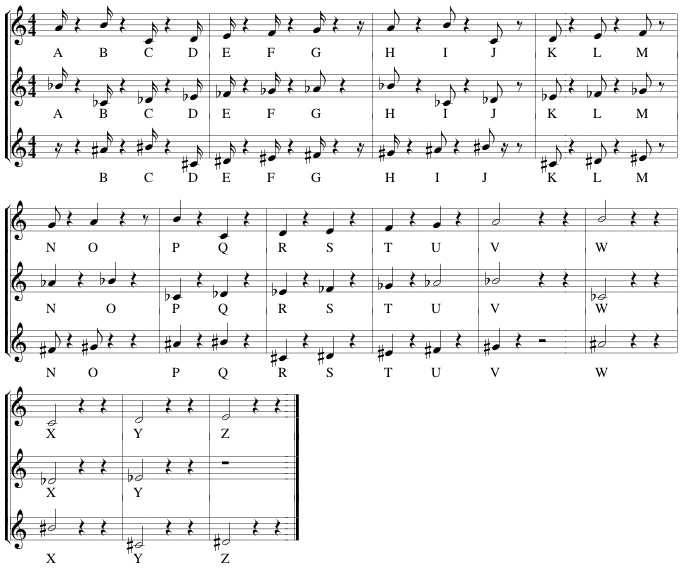
The rests in the music can correspond to breaks between words, but they are also used when needed so that each bar has four beats. Using the code given above, the deciphered message is:
As you may, or may not, know the number of gifts given on each day of the song is a sequence known as the tetrahedral numbers, which are formed by summing the triangular numbers. After twelve days the total number of gifts given is 364. A chiliagon is polygon with 1000 sides and the cube root of 1000 is 10. The final answer is then 364 × 10, which is 3640.
© The University of Manchester 2012–2021, All Rights Reserved
Contact us | Privacy notice