
Problem 8
Suppose that we have three circles such that each pair of circles touches at exactly one point, as with the black circles in the diagram. One can draw a fourth circle (the inner circle drawn in red) which just touches each of the first three circles.
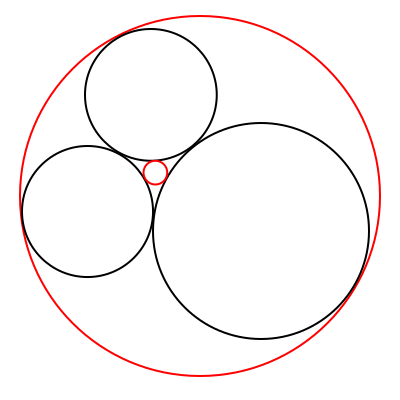
If the first three circles have radius $1/k_1$, $1/k_2$ and $1/k_3$ respectively, then the red circle inside them has radius $1/k_4$, where $$ (k_{1}+k_{2}+k_{3}+k_{4})^{2}=2\,(k_{1}^{2}+k_{2}^{2}+k_{3}^{2}+k_{4}^{2}).$$ Having drawn the red circle it is now possible to draw three further circles in the gaps around it, each new circle just touching three circles on its boundary. And then for each of the new circles we can draw a further three extra circles in the gaps around it.
Suppose that we iterate this procedure forever. The limiting procedure is called an 'Apollonian circle packing'.
If we start with three circles of radius $1/2$, $1/2$ and $1/3$, how many circles of radius greater than $1/150$ do we end up with in the limit? You should include the original three circles in your answer.
© The University of Manchester 2012–2022, All Rights Reserved
Contact us | Privacy notice