
Problem 8
Graphville is a small hamlet nestled in among the foothills of the Carpathian mountains. Every street in Graphville looks identical and there are no street names, it's not even possible to recognise one's own house from outside. To help people find their way home, the council put in place a one way system and paint each street either red or blue, as indicated in the diagram below. A novelty of the colouring is that, even if you don't know where you are, by following certain sequences of colours you can navigate to specific places.
For example, Steve lives at the junction marked in yellow, and by traveling from any starting node along streets coloured blue, red, red, blue, red, red, blue, red, red he will reach home.
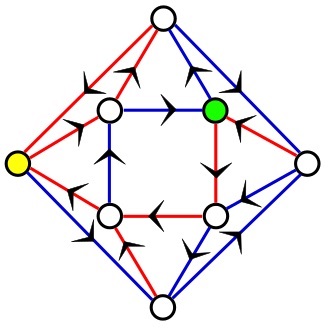
One day Steve makes a bit of a hash of getting home. Forgetting the magic sequence, he follows roads red, red, blue, red, red, blue. Then, realising he's in trouble, Steve asks his partner to wait on the porch so that he will know where he is whenever he reaches home. Finally, Steve flips a coin six times, travelling down a red road whenever it is heads and a blue road whenever it is tails.
What is the probability that, looking back on the list of 12 roads that he has travelled down, together with the knowledge of whether or not he can see his partner at each step, Steve will know where he is at the end of the process? Write your answer as an exact five-digit decimal ("0.abcde" for some digits $a$ to $e$).
© The University of Manchester 2012–2021, All Rights Reserved
Contact us | Privacy notice